LoL in-house team balancer
Updated: October 24, 2026
Pick the 10 (or 20) players and the AI splits them into the two most even teams. It looks beyond solo-queue rank — at how people actually do in your in-houses and which roles they want.
Why matching rank totals still gives lopsided games
The usual way to split in-house teams is to turn ranks into points and match the totals. Games still snowball one way: two players of the same rank can play very differently in your group, and one team can end up with three supports.
So ONNJ looks at three things together.
- Solo-queue rank (current and peak): a fair starting point even for people with no history
- Your in-house record: ONNJ's own MMR, built from games you actually played together
- Role preferences: up to three roles per player, so fewer people get stuck off-role
Three ways to build teams
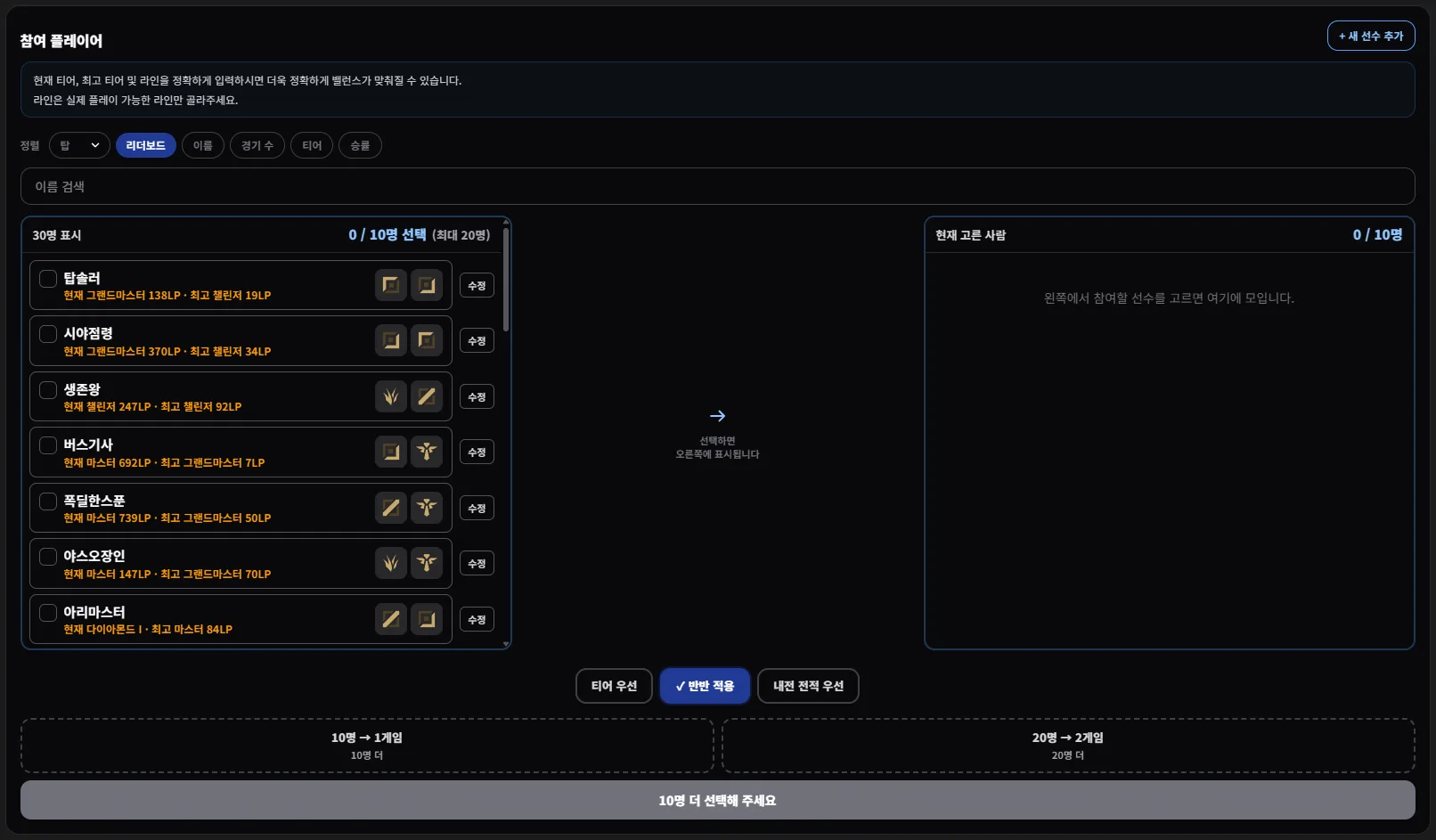
- Build with AI: when you have enough in-house games. Choose 'rank first / balanced / record first' and it builds right away.
- Build by draft: when history is thin. Captains take turns picking, and a coin toss decides who picks first.
- Lane balance: when you'd rather agree lane by lane. Compare each lane like a scale.
With 20 players it splits two games at once. Choose whether to mix skill levels evenly or split into upper and lower games.
Lock what you need
- Seat lock: put someone on a fixed team and role, like blue-side mid.
- Team lock: fix the team, leave the role open.
- Keep together: put duo friends on the same team.
Locks stay in place every time you rebuild.
How it differs from a spreadsheet calculator
A spreadsheet means typing ranks and fixing formulas every time. On ONNJ you add a summoner once — rank and roles fill in automatically — and the balance gets sharper as your games pile up.
On days you take sign-ups, jump from the sign-up list straight into the AI team builder with the same players.
FAQ
- Is the team balancer free?
- Yes. Create a group, add your summoners and it's ready.
- Does it work with no in-house history?
- Yes. It starts from solo-queue rank and leans more on real results as games are logged. A captains' draft also works well early on.
- Can it split 20 players?
- Yes. Twenty players are split into two games of ten at once.
- Can I see the scores it uses?
- The result shows an expected win rate. The underlying numbers (ONNJ's own MMR) stay private.