How to rank a LoL in-house — why win rate alone doesn't work
Updated: August 11, 2026
The trap of sorting by win rate, and how OP Score weighs contribution, win rate and games played together so a 2-0 record doesn't top the table.
The win-rate trap
The first thing anyone wants after collecting in-house records is a table. And the moment you sort it by win rate, something silly happens: the player who played twice and won twice sits at 100%, above someone who has played thirty games at 61%.
Nobody looks at that table and believes it. But sorting by win rate produces it every time. The problem isn't the sort — it's using a single number that says nothing about sample size.
Games played has to count
Win rate swings wildly when the sample is small. Two games gives you 100% or 0% routinely; thirty games almost never does. The same 100% carries completely different information depending on how many games sit behind it.
So games played belongs in the calculation: score low while the sample is thin, pay full value once it's thick. Do that and the table stops rewarding one hot night and starts rewarding showing up.
Winning isn't the same as playing well
Win rate has a second limit. It's a team game — you can play badly and still bank a win, or play the game of your life and get nothing because the other four lost their lanes.
That's why contribution inside the game has to be measured separately. Compare the ten people who played that game on damage, kill participation, vision, survival and objective work, and who actually performed becomes visible regardless of the result.
Three things at once
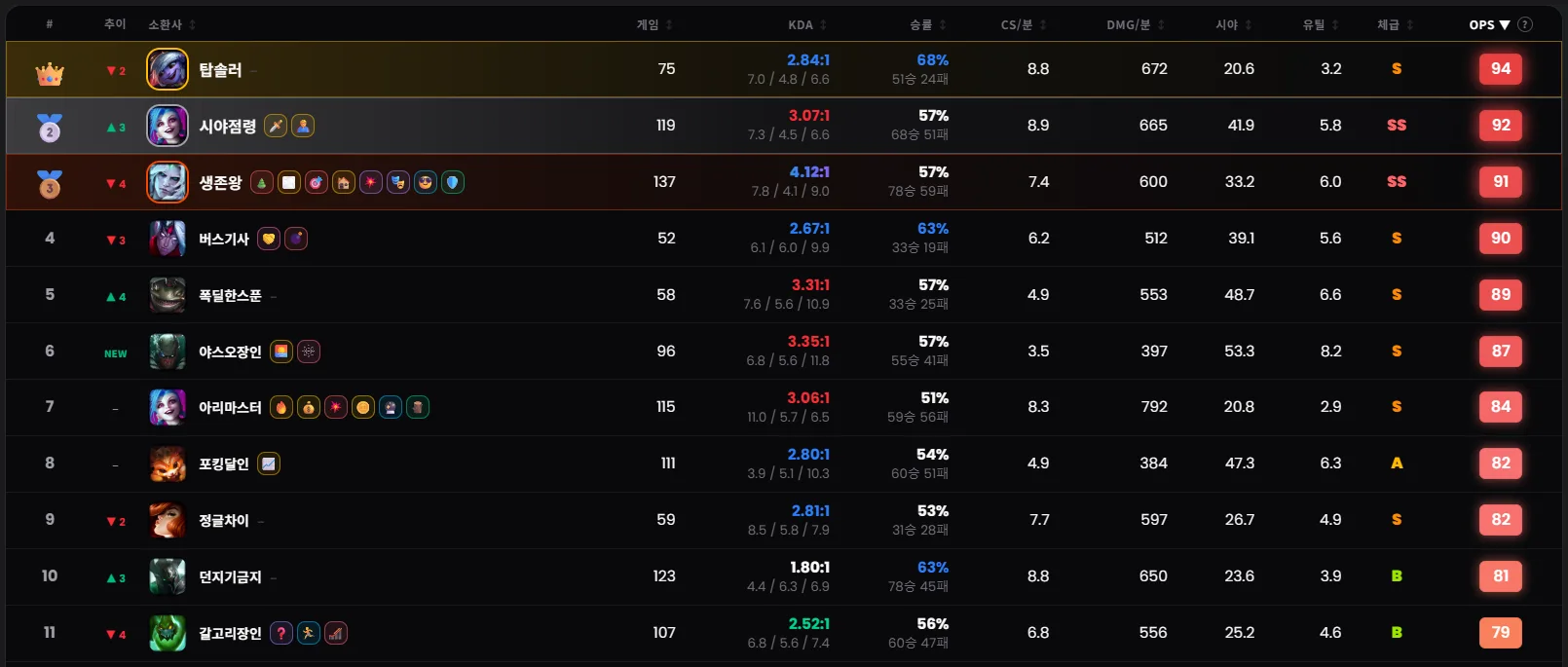
ONNJ's OP Score combines three things.
- Contribution — how much you did inside the games (NJ Score)
- Win rate — how often you actually won
- Games played — whether there is enough of a sample to trust
Being good isn't enough on its own, and neither is winning or grinding games. All three have to hold up. In practice, sorting this way makes 2-0 records disappear from the top.
We don't publish the exact weights or multipliers. Once the numbers are known, people play for the number instead of the game, and the table stops describing skill.
Written and maintained by the ONNJ team
This guide is written and maintained by the team that develops and runs ONNJ.
If you find an error or the guide differs from the current interface, please let us know by email.
onnj.official@gmail.com